



“You can’t stop progress, but you can help decide what is progress and what isn’t”
Ashleigh Brilliant.
This is the first in a series examining the popular discussion of the term AI. I believe the term is vague and confuses people. The topic does have positive and negative aspects to it.
We live in a time a technological miracles. The things we take for granted could not have been imagines 150 years ago. Each step progressed the way humans live. A couple of the most significant change was writing implements. The ability for all people to express and record thought.
This information may not change your opinion of AI, but give you perspective. Technology often brings change to how people work, and sometimes eliminates work for many people. We have been here before.
Reviewing Technological milestones through time
The Pre-Industrial & Printing Era (1500s–1700s)
This era shifted humanity from localized, oral, and manually duplicated knowledge to standardized, mass-distributed information.
- 1500s — Spread of the Movable Type Printing Press: Gutenberg’s 1440s invention reached mature global scale by the 1500s. It displaced thousands of professional scribes and monks who manually copied manuscripts.
- Labor Impact: Transformed writing from a slow, artisanal luxury into a mass-produced commodity. It birthed the modern publishing, legal, and academic industries.
- 1589 — The Stocking Frame (Knitting Machine): Invented by William Lee, this mechanical loom automated the creation of textiles, which had previously been knitted entirely by hand.
- Labor Impact: Queen Elizabeth I famously refused to grant Lee a patent out of fear it would ruin traditional hand-knitters. It laid the early socio-political groundwork for the Luddite movement two centuries later.
- 1642 — The Pascaline (Mechanical Calculator): Blaise Pascal invented the first mechanical adding machine to assist his father, a tax collector.
- Labor Impact: The earliest automated threat to “human computers” and accounting clerks. It proved that arithmetic execution could be outsourced to gears and wheels.
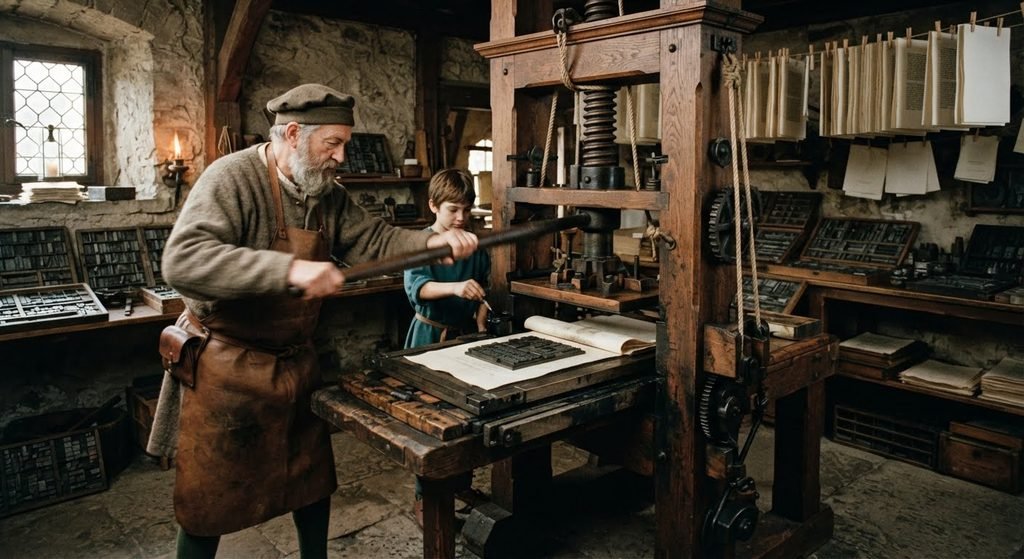
1500s — Spread of the Movable Type Printing Press: Gutenberg’s 1440s invention reached mature global scale by the 1500s. It displaced thousands of professional scribes and monks who manually copied manuscripts.
🏭 2. The First & Second Industrial Revolutions (1760s–1910s)
This era replaced human and animal muscle power with mechanical energy, sparking massive labor migrations from fields to factories.
- 1764 — The Spinning Jenny: James Hargreaves automated multi-spool textile spinning, allowing a single worker to produce the volume of eight hand-spinners simultaneously.
- Labor Impact: Radically devalued home-based artisanal weaving. This directly triggered the Luddite riots (1811–1816), where displaced workers smashed machines in protest of plummeting wages.
- 1781 — The Rotative Steam Engine: James Watt refined the steam engine to produce continuous rotary motion, allowing factories to move away from rivers and run constantly.
- Labor Impact: Wiped out traditional watermill operators and massive animal-labor ecosystems. It forced agrarian societies into heavily centralized urban manufacturing hubs.
- 1837 — The Telegraph & Morse Code: Samuel Morse and William Fothergill Cooke independently developed commercial electrical telegraph systems.
- Labor Impact: Displaced long-distance horse messengers (like the later Pony Express) and maritime signaling networks. It created the first instantaneous global communication workforce.
- 1913 — The Moving Assembly Line: Henry Ford deployed the first continuous assembly line for automobile production.
- Labor Impact: Reduced the time to build a car from 12 hours to 93 minutes. It shifted manufacturing away from elite, highly paid master mechanics toward a massive volume of low-skilled, highly repetitive factory line workers.
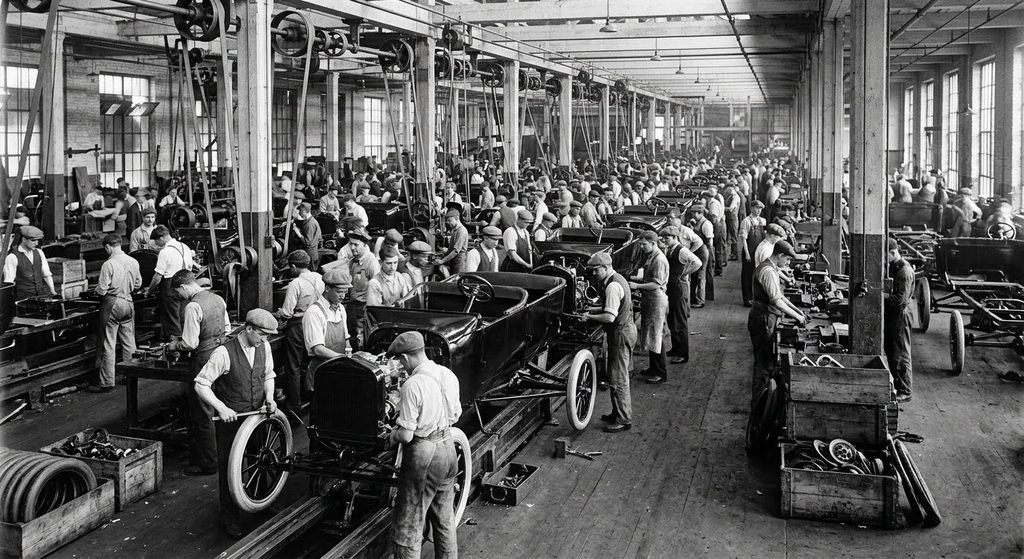
1913 — The Moving Assembly Line: Henry Ford deployed the first continuous assembly line for automobile production.
🏢 3. The Digital & Information Revolution (1940s–1990s)
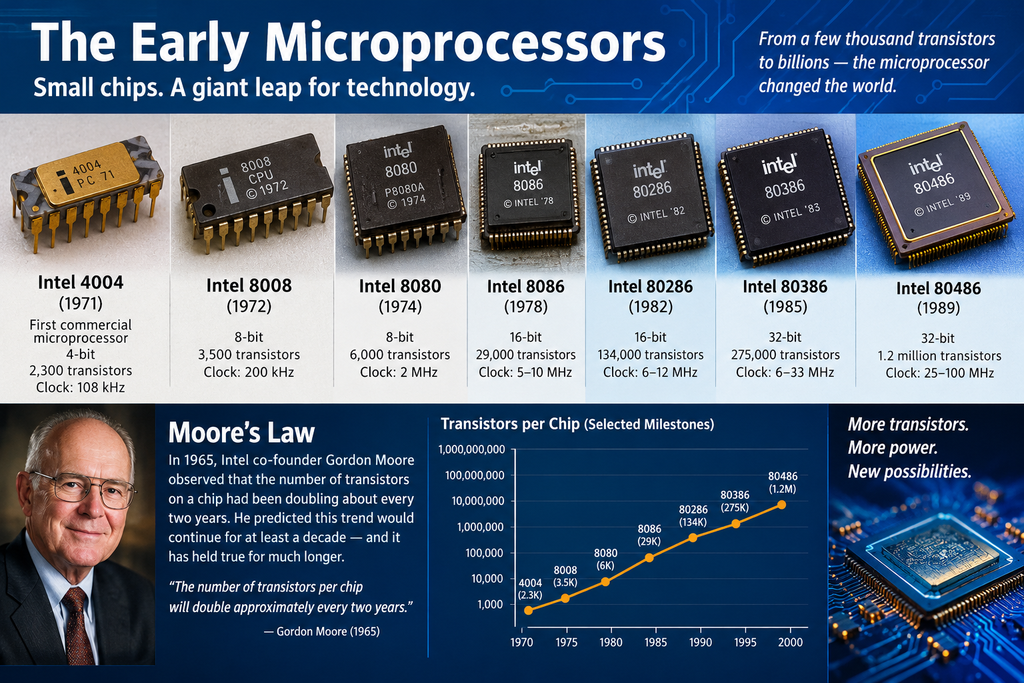
This era began the automation of white-collar clerical work, transforming offices from paper-and-typewriter hubs into digital processing nodes.
- 1947 — The Transistor: Invented at Bell Labs, this tiny semiconductor component replaced fragile, massive vacuum tubes to control electrical currents.
- Labor Impact: Enabled the extreme downsizing and exponential scaling of computers. It effectively began the slow phase-out of mechanical office machines and their manufacturing industries.
- 1971 — The Microprocessor: Intel introduced the 4004, placing an entire Central Processing Unit (CPU) on a single silicon chip.
- Labor Impact: Paved the way for personal computers, turning computing from a specialized corporate utility into an individual desktop tool.
- 1979 — The Electronic Spreadsheet (VisiCalc / Lotus 1-2-3): The launch of digital ledger software allowed users to automatically recalculate thousands of financial cells instantly.
- Labor Impact: Displaced massive corporate accounting pools. A single accountant using a spreadsheet could complete tasks that previously required an entire department weeks of pencil-and-paper calculations.
- 1991 — The Public World Wide Web: Tim Berners-Lee released the WWW to the public, creating a global decentralized network for information sharing.
- Labor Impact: Radically disrupted traditional travel agents, brick-and-mortar retail staff, print journalists, and postal workers by democratizing commerce and communication.
🌐 4. The Automation & Artificial Intelligence Era (2000s–Present)
The current era shifts automation away from strict, rule-based software toward probabilistic, cognitive systems capable of pattern recognition and content creation.
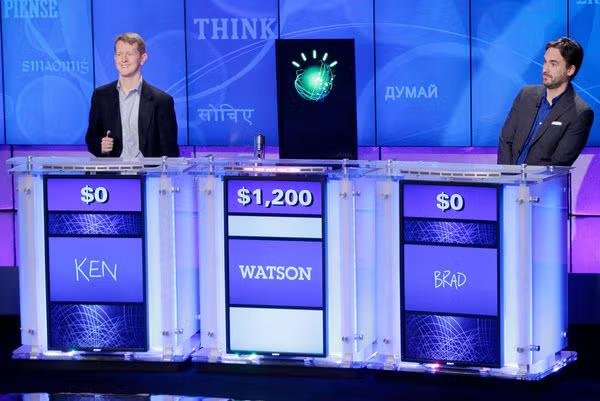
2011 — IBM Watson WinsJeopardy!
- 2011 — IBM Watson WinsJeopardy!: A cognitive computing system defeated the world’s top human champions in a televised natural-language competition.
- Labor Impact: Signaled to the market that computers were moving past rigid data entry and could parse human nuance, context, and unstructured data.
- 2012 — Modern Deep Learning (AlexNet): A neural network shattered records in computer vision at the ImageNet competition, proving that deep learning could effectively “see” and categorize the world.
- Labor Impact: Initiated the commercial push toward autonomous vehicles, automated medical imaging diagnosis, and quality-control robotics, threatening human inspection and driving jobs.
- 2022 — Generative AI & Large Language Models (LLMs): The public release of highly advanced transformers allowed individuals to generate human-grade writing, art, and programming code via simple text prompts.
- Labor Impact: Currently creating a massive “white-collar Luddite” shift. It is rapidly restructuring entry-level coding, graphic design, legal document drafting, and customer service operations globally.
📊 Direct Comparison of Labor Shifts
| Era | Core Energy Source | Displaced Labor Class | New Labor Class Created |
|---|---|---|---|
| Printing Era | Human Muscle / Water | Scribes, Calligraphers | Authors, Printers, Editors |
| Industrial Era | Steam / Coal / Oil | Artisans, Hand-Weavers, Horses | Factory Workers, Train Engineers |
| Digital Era | Electricity / Silicon | Clerical Typing Pools, Bookkeepers | Software Engineers, Data Analysts |
| AI Era | High-Density Data Centers | Content Drafters, Junior Coders | Prompt Designers, AI Auditors |